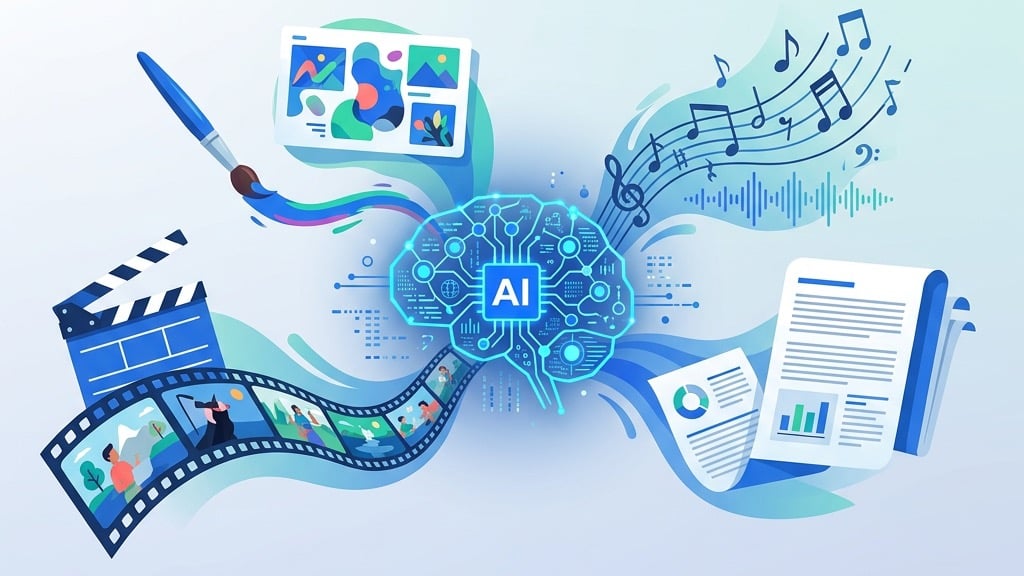
Last month, a short film made entirely by one person won an audience award at a regional film festival in Austin. The cinematography looked like a $2 million production. The soundtrack had original vocals. The script had been polished through dozens of drafts. Every single element was generated or assisted by AI. The audience had no idea until the director told them during the Q&A.
I keep thinking about that Austin story because it shows exactly where we landed in mid-2026. Those awful six-fingered hands and flat robotic voices feel like ancient history now. The tools got better, fast. AI makes videos, illustrations, full songs, and articles that look and sound like the real thing. Telling the difference takes effort, and sometimes it is genuinely impossible.
This raises a question that keeps getting louder: if AI can create anything, how do we know what's real?
AI Video: Solo Creators Are Making Cinematic Content
The biggest change in 2026 is AI video generation. Back in 2022, created clips seemed cool but also blunt. Today, edited footage from Runway Gen-4.5, Kling 3.0 and Google Veo 3.1 looks just as slick as any camera shot.
Kling 3.0 produces 4K native audio video, including forward facing camera angles and advanced motion such as a crowd striding through a marketplace or waves crashing against rocks. Runway allows the filmmaker to have complete control over the camera's movement and cut with the absolute precision of a director on a physically shot set. Google Veo 3.1 is being employed in marketing content that appears as if it was shot on location.
The real game-changer is the emergence of full pipeline platforms. Tools like LTX Studio and Melies let a single person go from script to storyboard to final video in one workflow. Character consistency, location matching, and style continuity are handled automatically. These used to require a team of 20 people and months of post-production work.
The biggest winners are solo filmmakers. A single designer working from a laptop can now create content that used to require an entire crew, studio and several million dollar budget. Production costs have fallen around 30% even for large studios who have now incorporated AI into their pipeline.
AI Images: Beyond "Good Enough" to Indistinguishable
AI-generated images crossed the "uncanny valley" threshold sometime in late 2025. By now, the quality gap between AI art and professional photography or illustration is effectively zero for most viewers.
Midjourney v7 is still the best for artistic, highly stylized images. This is the go-to tool for concept artists, marketing teams, and designers who need something with a particular vibe or look. GPT Image 2.0, built into ChatGPT, is best at complying with detailed text directions, and producing legible text within an image. Flux, the open-weight model from Black Forest Labs is popular for developers and other technical users who want to run image generation on their own hardware.
The problems that used to give AI images away are mostly gone. Hands look right. Text renders correctly. Backgrounds are consistent. The telltale signs that worked a year ago, like checking for distorted reflections or counting fingers, are no longer reliable.
This is important because images created by AI are now all over the place: product shots on an e-commerce site, profile pictures on a social network, illustrations on a news story, an ad campaign. Some of these are labeled. A lot of them aren't.
AI Music: Full Songs, Real Vocals, Zero Musicians
Music creation has quietly emerged as one of the most prolific domains for AI content. Suno v5 makes an entire radio-ready, full-length song from a text command. It manages voice, instruments, and song format. The emotional spectrum is jaw-dropping. Tell it to make a sad folk ballad or a happy dance track and it sounds like a professional studio.
Udio takes another route, this time offering the producer a direct, practical tool. Udio lets you remix a song, section by section, inpainting (cutting a piece of a song and adding it back in somewhere else) and exporting its constituent stems. For the serious music producer, it becomes a great collaborator without directly taking over.
The implications are huge. Music cues to accompany videos, podcasts, commercials and apps no longer have to be paid for with an up front licensing fee or session musicians. A creator can instantly craft a soundtrack for their work. Whether that improves or destroys the music industry is another argument, but the ability itself is indisputable.
AI Text: The Original and Still the Most Widespread
It all began with ChatGPT, which arrived on the scene in late 2022. Just four years later, text is the type of AI generated content most prevalent on the internet, with whole blog articles, product descriptions, emails, social media captions, essays, and books being written by large language models every single day.
The amount is staggering. It has been estimated that by 2026, in excess of 15 percent of all new content available online will be partially or fully produced by AI. This encompasses anything from informative, well-researched articles to downright spam.
Whereas detecting AI generated video and images is still relatively nascent, detecting AI text has become quite robust. There are statistical, sentence-level, and word-level signature-detecting tools that can accurately spot AI written text. However, keeping ahead of the technology remains a challenge as language models continue to improve and become impossible to tell apart from humans, requiring constant retraining of detector models.
The Trust Problem: When Everything Can Be Faked
This is the crux. Each of these breakthroughs is astounding individually. But altogether, they spell out something significantly more exciting: a world in which any form of content can be created from nothing, at scale, by anyone who can be plugged in.
That is not inherently bad. AI tools are democratizing creative work. People who could never afford a film crew or music studio can now tell their stories. Students can visualize concepts. Small businesses can create professional marketing materials. These are genuine improvements.
But it is the same technology that allows misinformation on scale that we have never seen. A deepfake video of a politician claiming things they didn't. A false article with AI-created "images" of a crime that never occurred. A cloned voice leaving a message that sounds like a loved one.
The question is not whether AI content creation will continue to improve. It will. The question is whether our ability to verify and authenticate content can keep pace.
How Detection Is Responding
Content authentication is advancing on multiple fronts, though no single solution covers everything yet.
Text Detection
AI text detection is the most mature category. Modern detectors use dual-model architectures that combine traditional machine learning with deep learning transformers. They analyze over 100 linguistic features, including sentence complexity, vocabulary distribution, and predictive patterns that AI models tend to produce.
The modern leading text detectors are now at the sentence level. This used to be opaque and only give you the results as a percentage, but now it points out passages that show AI usage. The results are more transparent and easier to act upon. And the detection technology has also gotten better for multi-lingual material. Some detectors support over 50 languages, and use de-biased models to avoid false positives for non-native speakers of English.
Image and Video Detection
Visual content detection is catching up but remains less reliable. Current approaches include analyzing pixel-level artifacts, checking metadata for C2PA credentials (a content provenance standard), and using reverse image searches to trace an image's origin.
The C2PA standard is catching on. It adds a cryptographic certificate to content as it's being made to build a verifiable chain of custody. Large camera companies and Adobe are already adopting it. However, the problem is metadata can be easily removed when images are posted on social media sites.
Audio and Voice Detection
AI voice detection analyzes audio for artifacts that synthetic speech engines leave behind: unnatural micro-pauses, overly consistent pitch, and spectral patterns that differ from recorded human speech. As voice cloning improves, these detectors are being retrained on newer synthetic speech models to maintain accuracy.
The Layered Approach
No single tool can catch everything across all media types. The most effective strategy in 2026 combines multiple methods:
- Use dedicated detectors for each content type (text, image, audio)
- Check metadata and content provenance (C2PA, EXIF data)
- Verify sources through reverse searches and contextual analysis
- Apply critical thinking: does the content have a credible origin?
What Content Creators and Consumers Should Know
If you create content, the growing presence of AI-generated material raises the stakes for proving your work is authentic. Freelance writers, journalists, and students all face situations where their human-written work might be questioned.
Protecting your authentic content
- Keep drafts, revision history, and research notes as proof of your process
- Run your own work through anAI detectorbefore submitting it
- Use tools that embed provenance data into your files
- Disclose any AI assistance you used and how you used it
- Verify AI-generated facts withfact-checking toolsbefore publishing
If you consume content, the best defense is informed skepticism. Not paranoia, but awareness. When you see a striking image, a dramatic video clip, or an unusually polished article, it is worth asking: where did this come from? Does the source have a track record? Can I verify this through other channels?
The Road Ahead
AI content generation and AI content detection are locked in what researchers call an arms race. Generators get better. Detectors adapt. Generators evolve again. This cycle will continue.
But the trajectory is not hopeless. Several trends point toward a more trustworthy future:
Provenance standards are gaining ground. C2PA and similar frameworks are being adopted by major platforms and device manufacturers. If widely implemented, they could create a reliable way to verify where content originated and whether it was modified.
Regulations are emerging. The EU AI Act and similar legislation in other regions now require disclosure of AI-generated content in certain contexts. AI content laws are evolving fast, and they are starting to hold platforms and creators accountable for transparency.
Detection technology is improving across all media types. Text detection leads the pack with accuracy rates that make it useful for practical screening. Image, video, and audio detection are following, with each generation of detectors closing the gap against the latest generators.
Public awareness is growing. People are becoming more media-literate. The idea that "seeing is believing" is being replaced by a healthier habit of verification. That cultural shift might be the most important development of all.
The world where AI creates films, art, music, and text is already here. It is exciting and it is risky. The creative possibilities are enormous. So is the potential for abuse. What separates a future of innovation from a future of misinformation is our collective ability to ask one simple question: is this real?
The tools to answer that question exist today. They will need to keep getting better. But the habit of asking it? That starts with us.