99%
Detection accuracy
Measured on diverse datasets of AI-generated versus human writing, and retested as new models ship.
Check whether text was written by AI. Paste text or upload a file for a free AI score, no signup required.
Add text to start your scan
Paste from your clipboard, upload TXT, PDF or DOCX, or just start typing.
From text to evidence
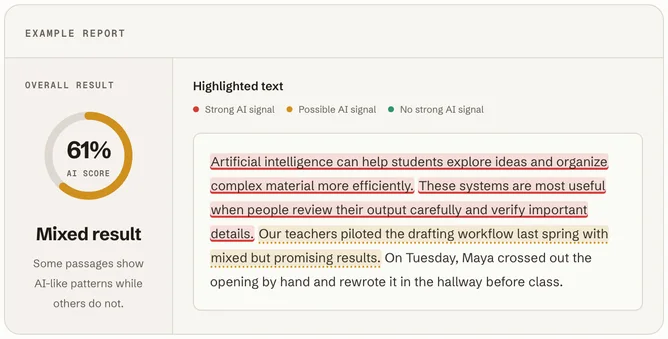
See where a signal came from instead of relying on one dramatic percentage.
Paste your text, upload a TXT, PDF or DOCX file, or start with a local example.
The analysis begins only after you choose Scan for AI. Your text is not sent while you type.
Start with the overall AI score, then read AI-like passages highlighted in the full text.
Accuracy
The engine behind detecting-ai.com pairs a feature-based classifier with a fine-tuned transformer and calibrates the two into one score. Both error directions are measured: how much AI-generated text gets caught, and how often human writing is wrongly flagged. When the call is close, the report shows the sentences so you can check the verdict yourself.
99%
Measured on diverse datasets of AI-generated versus human writing, and retested as new models ship.
<1%
Calibrated confidence scoring reduces language-related bias and keeps wrong flags on human work rare.
1B+
The detection engine has been exercised on more than a billion human-written and AI-generated samples.
Method
Structure is preserved, eligible text is divided into sentences, and each sentence is scored independently for signs of AI-generated text. The document signal is the average of those analyzed scores.
A high document signal can contain low-signal passages, and a low document signal can still contain sections worth reviewing.
Short, translated, heavily edited or formulaic writing can be harder to classify. Scores may change as the text changes.
A model score cannot establish authorship, intent or misconduct. Treat it as one input alongside drafts, sources and conversation.
Coverage
Model names describe the text families this AI content detector is designed to review, not partnerships or guaranteed source attribution.
| Text family | Designed to review | Result |
|---|---|---|
| OpenAI | ChatGPT output from GPT-5, GPT-4o and earlier GPT models | AI score + highlighted text |
| Anthropic | Claude model family | AI score + highlighted text |
| Gemini model family | AI score + highlighted text | |
| Mixed drafts | Human-edited and AI-assisted writing | Different signals highlighted in context |
Use cases
Anyone reviewing writing they did not watch being written. The common thread is care: the score opens a conversation instead of ending one.
Identify passages worth discussing while keeping drafts, sources and student context in the decision.
Triage contributed drafts and focus attention where the writing pattern changes sentence by sentence.
Add a measured authorship signal to an existing review workflow without treating it as proof.
See how revisions change the signal before sharing work with a client, teacher or editor.
Developers
Everything the workbench does is available programmatically. Score documents from your own pipeline with the AI detector API, or connect the MCP server so your agents can check text for AI patterns mid-conversation.
Before you trust a score
Straight answers about what an AI detector can and cannot do. Knowing the difference is what makes a score worth using.
The detecting-ai.com model preserves the document structure, separates eligible text into sentences, scores those sentences independently, and averages their scores into the document signal shown in the report.
The model detects AI-generated text with 99% accuracy across diverse datasets and keeps the false positive rate under 1%. Long, unedited samples are the easiest case; short or heavily edited passages carry more uncertainty, which is why every result also highlights the exact sentences behind the score.
It happens, and it does not mean you did anything wrong. Formulaic structure, stock phrasing and very uniform sentence rhythm can resemble model output, especially in short samples. Open the highlights, revise the sentences that read like boilerplate, and scan again. The detector responds to the writing, not the writer.
No. AI detection is a probabilistic review signal, not proof of authorship or misconduct. Consider drafts, citations, writing history and the surrounding context before making a decision.
Longer, coherent samples generally give the detector more useful context than isolated sentences. Short or heavily edited passages can carry more uncertainty.
You can upload TXT, PDF and DOCX files. PDF and DOCX text is read privately in your browser only after you choose a file, so document parsers do not slow the initial page load. Scanned PDFs need OCR and are not supported yet.
The detector is designed to review patterns commonly found in text from GPT, Claude and Gemini model families, including edited or mixed drafts. It does not identify a specific generator with certainty.
The detector supports text in many languages. Paste or upload your text in its original language and review the score together with the sentence-level evidence.
Every scan evaluates the current sentence wording and boundaries. Changes to rhythm, phrasing, punctuation or structure can affect individual signals and the document average.
Judge any detector on three things: how it treats human writing that merely looks formulaic, whether it shows sentence-level evidence instead of only a percentage, and whether it keeps uncertainty visible. detecting-ai.com is built around all three. No signup is required, and every score comes with the highlighted sentences that produced it, so you can judge the verdict instead of trusting it.
Free text check
Free scans need no account. If a flagged draft needs work, you can humanize AI text and review every edit before it ships.